
Most AI-related investment conversations start and end with a single chip company. That framing captures one layer of a much larger economic structure. Training and running large-scale AI models requires power generation, physical infrastructure, cloud platforms, foundation models, and the software layer that eventually reaches an end user. Each of these layers has a different risk profile, a different set of dominant companies, and a different way for capital to enter.
This article sets out that structure as seven layers, describes what sits in each one, and notes where relevant listed exposure exists. It is intended as an analytical framework rather than a recommendation to buy or hold any of the companies named. Some of this exposure is available to Luno clients through tokenised equities and ETFs, referenced where applicable.
The AI stack, layer by layer
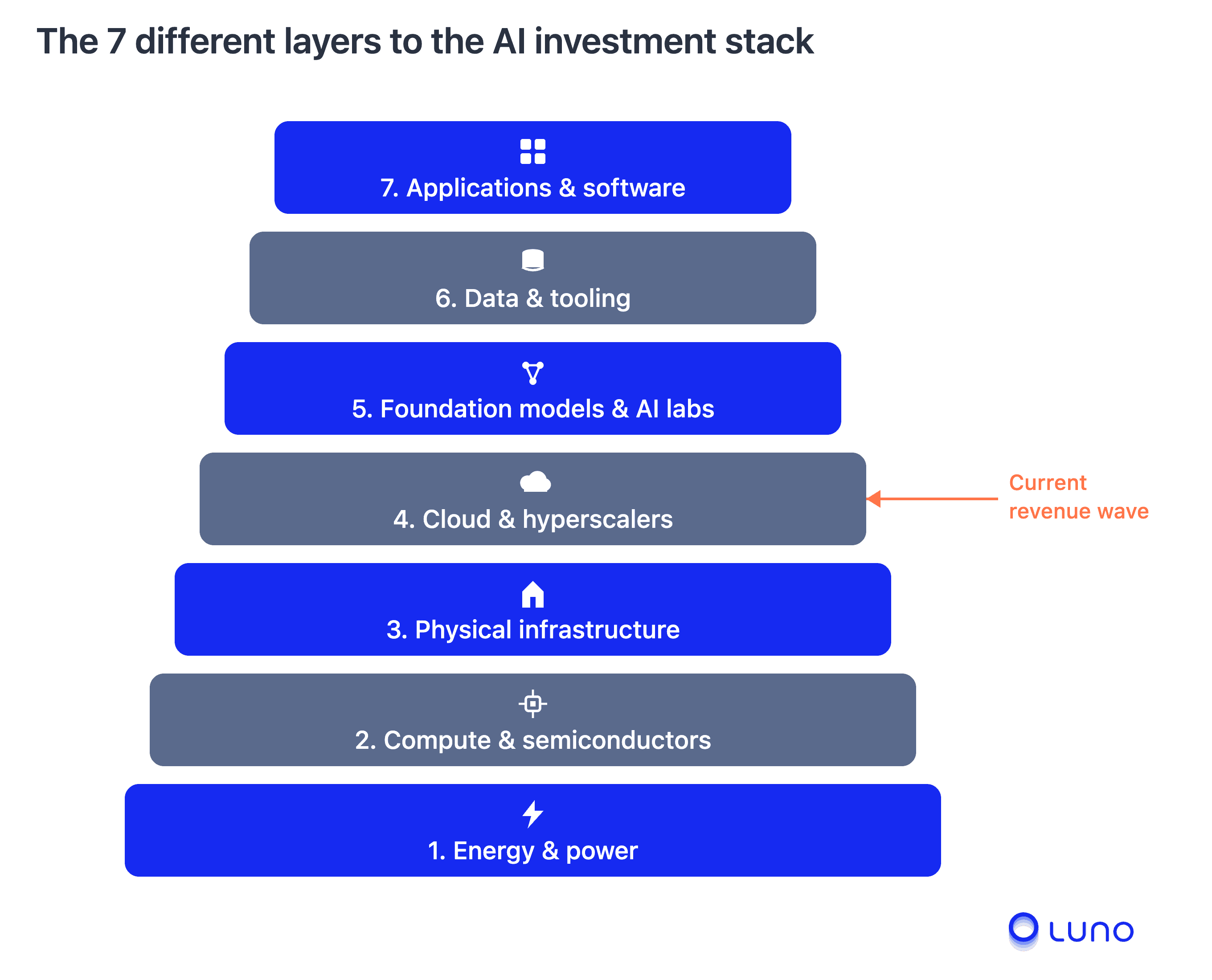
The stack below moves from the physical base of the AI economy (electricity and hardware) up to the layer most investors already recognise: consumer and enterprise software. Value, capital intensity, and competitive dynamics differ meaningfully by layer, which is the central reason for separating them out.
1. Energy and power
AI compute is now a grid-capacity constraint as much as a chip-supply one. Training and running large models requires sustained, high-density electricity, and utilities, grid operators, and power generators sit at the base of the stack as a result.
The International Energy Agency reports that global electricity demand from data centres grew 17% in 2025, with demand from AI-focused facilities specifically growing 50% over the same period. Separately, the IEA forecasts total data centre electricity consumption will exceed 1,000 terawatt-hours in 2026, roughly comparable to the annual electricity use of Japan.
Representative companies: Constellation Energy, Vistra, GE Vernova, NuScale Power, Talen Energy.
2. Compute and semiconductors
This layer covers the chips and accelerators that run AI workloads, plus the upstream companies that make chip production possible: foundries, lithography equipment makers, networking silicon, and memory manufacturers. It is the layer that has drawn the most retail attention, and also the layer where demand data is most visible.
The Semiconductor Industry Association expects global chip sales to exceed $1.5 trillion in 2026, with memory products recording particularly sharp growth as AI infrastructure demand pulls on high-bandwidth memory supply.
Representative companies: Nvidia, AMD, Broadcom (design); TSMC (foundry); ASML (lithography); Arista Networks (networking); SK Hynix and Micron (memory).
For a closer look at how this layer connects to big tech's build-out spending, see why big tech is pouring billions into data centres.
3. Physical infrastructure
Beneath the chips sits the physical facility: the data centre itself, its cooling and power-distribution systems, the servers racked inside it, and the real estate investment trusts (REITs) that own many of these buildings. This layer is capital-intensive and comparatively slower-moving than the compute layer above it, which gives it a different risk and return profile.
Representative companies: Equinix, Digital Realty (data centre REITs); Vertiv (thermal and power management); Super Micro Computer, Dell Technologies (servers).
4. Cloud and hyperscalers
The platform layer rents compute at scale to enterprises and developers, sitting between the physical infrastructure below and the models trained on top of it. This is arguably the layer most easily overlooked, since hyperscalers are usually discussed as "tech stocks" rather than as AI infrastructure providers in their own right.
According to reporting compiled by CNBC from company guidance, the four major hyperscalers plan combined capital expenditure of close to $700 billion in 2026, directed overwhelmingly at AI data centre build-out, custom silicon, and GPU procurement.
Representative companies: Microsoft (Azure), Amazon (AWS), Google (Cloud), Oracle, CoreWeave.
Because several hyperscalers appear across both major US indices, this layer connects directly to the question addressed in the S&P 500 vs Nasdaq 100.
5. Foundation models and AI labs
This layer covers the organisations training frontier AI models. Most of the highest-profile labs remain privately held, which means direct listed exposure is limited. Where public exposure exists, it is typically indirect, through a parent or major investor rather than the lab itself.
Organisations: OpenAI, Anthropic, Google DeepMind, Meta (Llama), xAI, Mistral. Listed exposure to this layer is largely indirect, via Alphabet and Meta as parent or affiliated entities.
6. Data and tooling
Sitting between the model layer and the applications built on top of it is a middleware layer: data platforms, vector databases, orchestration tools, and labelling or MLOps services. This layer has the smallest public-market footprint of the seven, with a mix of listed and private companies.
Representative companies: Databricks, Snowflake, Palantir Technologies, Hugging Face, Scale AI. Several of the most prominent names in this layer remain privately held.
7. Applications and software
At the top of the stack are the products end users actually interact with: software built on top of foundation models and cloud infrastructure, sold to consumers or enterprises. This is the layer where AI capability turns into a specific, priced product.
Representative companies: AppLovin, ServiceNow, Salesforce, Adobe, alongside a long tail of AI-native software companies.
Investment waves: capital moves through the stack in phases
The seven layers do not attract capital, or generate returns, on the same timeline. The AI build-out has so far moved through recognisable phases, with each layer's investment case maturing at a different point.
The first wave was infrastructure spending: capital committed to energy, chips, and physical facilities before there was clear evidence that the resulting compute would be monetised. This is the phase reflected in the hyperscaler capex figures cited earlier in this article, and it is largely a spending story rather than a revenue one.
The wave underway now in 2026 is different. It is the point at which that infrastructure spending starts converting into measurable, reported cloud revenue, rather than remaining a forward-looking capex commitment. This is the layer where tangible, quarter-on-quarter evidence of return is currently most visible.
Amazon Web Services reported second-quarter 2026 revenue of $42.2 billion, up 37% year over year, its fastest growth rate in 18 quarters, taking its annualised revenue run rate to $169 billion.
Microsoft reported that Azure and other cloud services revenue increased 39% in the same period, with the company noting continued growth across all workloads and ongoing capacity constraints relative to demand.
Google Cloud's growth accelerated further still: Alphabet reported Google Cloud revenue of $24.8 billion in Q2 2026, up 82% year over year, with cloud operating income nearly tripling over the same period as enterprise AI infrastructure and solutions demand scaled.
Taken together, these figures are the clearest evidence available that the capital committed in the first wave is now converting into reported, growing revenue at the cloud layer specifically. That does not mean every layer is at the same point in its own cycle. Foundation models remain largely pre-revenue relative to the capital invested in them, and the application layer is still early in demonstrating which AI-native products generate durable, repeatable revenue. Investors evaluating a specific layer should ask which phase that layer is currently in, rather than assuming the AI investment case matures uniformly across the stack.
Where this fits for investors
The value of separating the AI economy into layers is not to rank them, but to see where concentration risk actually sits. Several of the largest companies named above, including Nvidia, Microsoft, Alphabet, and Meta, appear in three or more layers simultaneously: as chip designers, cloud operators, model developers, and infrastructure spenders at once.
That overlap has a measurable effect on broad market indices. RBC Wealth Management notes that the top 10 holdings in the S&P 500 reached a record 40.7% of the index's total weight in 2025, up from a stable 18 to 23% range through most of the prior three decades, driven largely by megacap technology and AI-related names.
For an investor building exposure to the AI economy through a broad index, this means a large share of that exposure is concentrated in a small number of companies that span multiple layers of the stack, rather than being distributed evenly across it.
Luno clients can access this exposure through tokenised US equities and ETFs, including QQQx (tracking the Nasdaq 100, which is weighted heavily toward layers 2, 4, 6, and 7) and SPYx (tracking the S&P 500, which adds broader exposure including utilities relevant to layer 1). Neither product isolates a single layer of the stack, and both carry the concentration characteristics described above.
Frequently asked questions
What is the AI investment stack?
It is a framework for separating the AI economy into distinct layers, from the physical infrastructure that powers AI (electricity, chips, data centres) through to the cloud platforms, model developers, and software applications built on top of it. The framework is descriptive, not a ranking of which layer performs best.
Which layer carries the least concentration risk?
Concentration risk varies by layer, but the compute, cloud, and foundation-model layers are currently the most concentrated, with a handful of companies (Nvidia, Microsoft, Alphabet, Meta, Amazon) appearing across several layers at once. The energy and physical infrastructure layers involve a broader set of companies, though they carry their own capital-intensity and regulatory considerations.
Can I get exposure to AI infrastructure without buying individual chip stocks?
Broad index exposure, such as through the Nasdaq 100 or S&P 500, provides indirect exposure to multiple layers of the stack at once, including chipmakers, hyperscalers, and some infrastructure names. This comes with the concentration characteristics described above, since index weightings are driven by market capitalisation rather than layer diversification.
Are data centre REITs the same as AI stocks?
No. Data centre REITs such as Equinix and Digital Realty are real estate companies that own and operate the physical facilities housing servers and networking equipment. They benefit from AI-driven demand for data centre capacity but have a different business model, cost structure, and risk profile to chipmakers or software companies.
What are QQQx and SPYx?
QQQx and SPYx are tokenised equity products available on Luno that track the Nasdaq 100 and S&P 500 indices respectively. They provide broad market exposure rather than isolated exposure to any single layer of the AI stack described in this article.


